Thursday, February 21, 2019

Re-visiting Gamification


I have daydreams and ideas of this perfect site forming and being a beacon of inspiration and hope to all who come here and look. A bastion of knowledge of where to go and how to start. I don't really know where to begin and how to go about things.

I just recently came across Mr. Michael Matera's podcast, website and Youtube channel. I've listened to a couple of the more recent episodes on the way to and from work and they have some content but seem to be lacking something, too. There's a lot of "talk" without substance. Wait a second... I mean, there is substance to the talk, but to me, it's like eating a chicken wing or even a crab leg: a lot of work for a little payoff. I realize this is very one-sided of me. I've only listened to two episodes so far and one episode was mostly of two women just laughing. I didn't watch it on Youtube (yet) so I'm sure I'm missing something, but on the podcast format, it seemed like a lot of wasted time, but as he said, it's unedited, which is good! They talk about some things I want to go into in more detail, but let's make that another post. :)
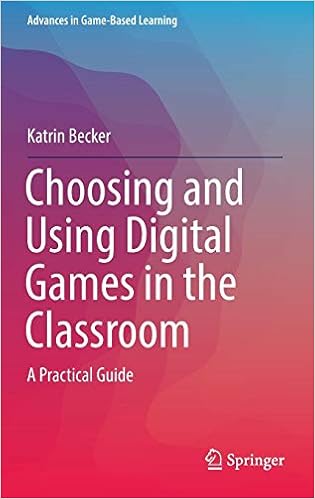
I took 2 classes in pursuing my masters in the hopes that I would learn more about gamification. One class was too short to be meaningful enough. The other class, the teacher disappeared and we mostly taught ourselves. HOWEVER, the second class did introduce me to a pretty good handbook for game-based learning (not so much gamification). That book was Katrin Becker's Choosing and Using Digital Games in the Classroom: A Practical Guide (Advances in Game-Based Learning). It discussed a lot of theory and such behind how games should be evaluated and rated; things I had never really considered before. These are things I like to think I do sort of intrinsically but are hard to put in words. However, it has some great ideas in there and I guess that's where I am going to go with this post.

So, I am a teacher that uses Classcraft to help me gamify my classroom. It's a wonderful suite of tools, but I can't help but think about how much better it could be. Boss battles are great and the kids beg for them, but it needs some competition components to it. A team should be able to "steal" an answer and teams should ALL have to answer, not just one. One day, I'll learn some coding, but we'll get there.... Speaking of which, I really do need to email the people at Gimkit. A high schooler created that. What software language and how? That's what I would like to learn.

So anyway, I've been contemplating some alternative activities for my students. Today, we were doing a boss battle in Classcraft using Internet Acronyms. Here is a link to my boss battle. Once we were done, the kids were complaining about wanting some more of the ones they use. They don't know acronyms like AFK, ROFL, and IMNSHO. I thought these were BASIC ones, but they seem to think they're hard. They want ones like STG (Swear to God), HML (Hit My Line), HMP (Hit My Phone) and GTG (Got to Go). [And you don't know Tigger's TTFN? Ta-Ta For Now!?]

Image result for tigger ttfn

But I digress. What, then, I ask myself, are some activities I can offer kids that are "fun" and unusual and out of the ordinary? Something that allows them to be creative and do more? Well, how about letting them talk in their own lingo and teach a concept to a 'friend'? There are sites out there that let you make mock iPhone chat logs and such and using that as a way for students to post a review. Posting it in a forum or such where others can read others would be even better. Perhaps even limiting it for the students that it can be "one screen's worth" only could add a level of challenge to the activity. I need to find a good source for this type of resource and amend this post, but for now, that's my idea of the moment. I'm posting it here in the hopes that maybe I'll remember it and use it!

Monday, May 5, 2014

A post for Jesse

     I recently had the opportunity to speak with a former student of mine about this idea of gamification. He's played games like World of Warcraft and would be mortified if I called him out here, so I'll just call him Jesse.

     I explained the basic premise to Jesse something like this: "Essentially, the idea goes like this: In class, I assign students work. They do it, hopefully learning something and get a grade for it. Now, think of a videogame. You get a quest. You do it, learn how it works and get experience and rewards for doing it. Depending on the game and the quest, sometimes you can do it over and over again, improving each time and learning more and more from it."

     Jesse laughed at me. "That's so nerdy! People are just going to laugh at you. All you're doing is doing the same thing and calling it something different."

     No, it's not quite the same thing. There will be badges. They're virtual badges, yeah, but they'd exist and be there. (Even XBOX achievements are virtual badges). These badges help denote certain things.

     There would be a leveling system. Now, the question is how far and how exactly, but it would exist. Perhaps each "assignment" or "Quest" would give a certain amount of experience plus a certain amount of 'gold' -- the gold could be used to buy your grade and the XP would go to apply to your level. Bear with me, here, this is just an IDEA now. I'm throwing things up here to see how they look and if they'd work.

     As you level, you'd gain skills and feats. Eventually, there could be feats as powerful as "Once per test, have the teacher check your answer on a single test question."

     There could be static rewards, such as "earn a piece of candy"

     There's lots of ways to do this.

     Over at classrealm, he tracks individual levels and CLASS levels. When the class reaches a certain point, they get rewards, including material things like an ice cream party.

     Another thing he does at Classrealm is allow students to choose their own classes. You can see more of this here. He does some pretty cool things, in my opinion.

     One of the things that sold me on this idea was the following video. Watch it and LISTEN. Listen to the logic. It makes sense. Then why am I not doing it yet?


Thursday, May 1, 2014

Perhaps one of the big concepts here are summarized in a Whitepaper paper by Haskell called "Understanding Quest-Based Learning" (without going into the subtitle). It can be found here. It is a good paper in helping to prove its points. Perhaps I should actually take time to read it instead of clicking through it, but it seems more of a sales pitch for gamification than anything else. I've already bought the line. It's a good concept. Now, let's teach me how to do it. Time to email Haiku. They've implemented badges. They need to implement requirements for badges so that they can be assigned automatically instead of manually.

Friday, April 25, 2014

Lab Progression

One of the things I've pondered for a long time as a classroom teacher, regardless of student involvement in gamification and such, is that students need a nice progression in labs. They need to learn basic skills.

What may those lab skills be?

* Convert metric quantities between metric quantities using prefixes.
* Convert metric quantities with Imperial units [not so helpful for the state exams as it doesn't show up on there]
* Measure length with a ruler
* Measure volume in a pipet, in a graduated cylinder and more
* Measure mass on a scale.

I could see these being a string of labs but ultimately, I need a set of devices that are pretty standardized to have students measure year in and out.

Part of the problem in standardizing my items is that year to year, due to the economy, items shrink and grow. Companies change and products on sale change.

For example, those freezer pop things we all ate as kids? Yeah, on the right there. Those things.

Those things would be AWESOME for volume measurements. Measure it. Now, calculate what it should be. Things like this. They're not too expensive and they get the kids interests because they're consumer chemistry type labs.

I am horrible at labs and need to do more.

But as students gather their basic lab skills, they can earn badges (or achievements). I could easily see one being called Metric Master. Perhaps several levels... Metric Novice, Metric Apprentice, Metric Journeyman, Metric Artisan, then finally Metric Master. (Yeah, I'm kind of channeling the Lord of the Rings Online crafting tiers, but hey! They work and get the idea across!)

The badges would be all similar, but slightly different. I certainly need to do this through the course, but the edges would represent the levels. Higher level badges would have fancier borders and perhaps stars or wings or leaves or something more. The beginner level badges would have solid and plain borders.

But, I'm digressing.... More food for thought. :)

Friday, March 14, 2014

Random Link post

Check out this link

http://www.yukaichou.com/gamification-examples/top-10-education-gamification-examples/#.UyNbqV46I18

Obligatory first post

I suppose in the pursuit of one's career, a person finally becomes opinionated strongly enough about certain things they decide they need to flood the internet with yet more opinions. Perhaps people will listen. Most likely, this blog will disappear in obscurity and ignored by most.

But none of that matters to me. Not anymore. When sunshine leaves the world, you stumble in the dark and do your best to minimize the scars and scratches and scrapes one incurs in the process.

So I want to refocus in two ways in this 'professional' blog related to education.

1) I want to establish and grow a Teachers Pay Teachers website. I have developed several resources I believe are worthwhile and good. In addition, it will hopefully help encourage me to improve the lessons I offer my students and by proxy, others.

There are problems in this: I teach mostly using the Haiku LMS, which is my school's choice. I really like Haiku. It's good. But where does it fit into a TpT store? How many people would use electronic copies for online course work? I foresee a lot of multiple choice questions being my offerings. But is there a market for there?

2) I want to explore and develop a 'gamified' course. Personally, I've always thought Physical Science would be best to start this. It's modular and fits well with this mode. There's lots of options of things to do, but many of these are limited by the medium you use to do it.

I came across this website, http://lectora.com/blog/thursdays-trending-e-learning-topic-gamification/, and if you follow the first link on the entry, it has a list of 4 items.

One of those items is Easter Eggs. Hidden mini-games and the like that keep students from just clicking through the information presented.

Not a bad idea. Not a bad idea at all.